Some languages like Chinese, Vietnamese, and Thai are tonal. Tones of vowel pronunciation are phonemes! Watch these two brief tutorials on tones in Vietnamese (REQUIRED, about 5 minutes total):
[You can stop now. Everything below this point is optional and will not appear on exams. It is fun though]
We have mentioned the click phonemes common in some Southern African languages. Here's a nice video that gives you good examples of clicks:
If you'd like a more complete understanding of Vietnamese tones, you can watch this video (8.5 minutes).
Now, if you really want to be an expert on tonality in languages, you can check out the Chinese poem "Lion-Eating Poet in the Stone Den" by the Chinese-American polymath Yuen Ren Chao (1892-1982). Chao was a philosopher, mathematician, linguist, poet, and composer. He was a professor in China, and at Harvard and at Berkeley, where he spent most of his career (and where he was a colleague of the famous anthropologist A. L. Kroeber, Boas' first Ph.D.). Anyhow, Chao wrote the poem in the early 20th century as a demonstration of the difficulties of converting Chinese characters to phonetic Latin characters. The poem is 93 words long and, in Mandarin, each word is pronounced the same except for the tone. Hear it read in the YouTube video below.
But wait, there's even more. In the last line of the poem, the author challenges his readers to explain the poem. Some have taken the challenge literally. Here's an analysis of the poem.
In reality, the poem is somewhat of a parlor trick: that is, it works, but if you walked up to a native Mandarin speaker and began to recite this poem, they would just look at you funny. It's not something the average person could understand without context and preparation. In fact, since it uses obscure characters, most highly educated Chinese can't read it either. It's really for scholars.
Of course, you can do things that are at least somewhat similar in English. Consider the perfectly logical and grammatically correct sentence "Buffalo buffalo Buffalo buffalo buffalo Buffalo buffalo." If you're confused, check out this Wikipedia article on it.
English does not have tones and it's hard for English speakers to really grasp them. However, like all other languages, it does have intonation. That is utterances have melodic patterns, stress, and rhythm, and these carry meaning. For example the difference between "He found it on the street." and "He found it on the street?" is intonation. And it changes the meaning of the sentence. Though it is definitely not the same, intonation may help us grasp tonality. Consider the following (vaguely) famous example. It will really help if you read this out loud. You'll begin to understand it after the first sentence or so (if you don't, just skip to the end):
Wants pawn term dare worsted ladle gull hoe lift wetter murder inner ladle cordage honor itch offer lodge, dock, florist. Disk ladle gull orphan worry putty ladle rat cluck wetter ladle rat hut, an fur disk raisin pimple colder Ladle Rat Rotten Hut.
Wan moaning Ladle Rat Rotten Hut's murder colder inset.
"Ladle Rat Rotten Hut, heresy ladle basking winsome burden barter an shirker cockles. Tick disk ladle basking tutor cordage offer groin-murder hoe lifts honor udder site offer florist. Shaker lake! Dun stopper laundry wrote! Dun stopper peck floors! Dun daily-doily inner florist, an yonder nor sorghum-stenches, dun stopper torque wet strainers!"
"Hoe-cake, murder," resplendent Ladle Rat Rotten Hut, an tickle ladle basking an stuttered oft.
Honor wrote tutor cordage offer groin-murder, Ladle Rat Rotten Hut mitten anomalous woof.
"Wail, wail, wail!" set disk wicket woof, "Evanescent Ladle Rat Rotten Hut! Wares are putty ladle gull goring wizard ladle basking?"
"O hoe! Heifer gnats woke," setter wicket woof, butter taught tomb shelf, "Oil tickle shirt court tutor cordage offer groin-murder. Oil ketchup wetter letter, an den—O bore!"
Soda wicket woof tucker shirt court, an whinny retched a cordage offer groin-murder, picked inner windrow, an sore debtor pore oil worming worse lion inner bet. Inner flesh, disk abdominal woof lipped honor bet, paunched honor pore oil worming, an garbled erupt. Den disk ratchet ammonol pot honor groin-murder's nut cup an gnat-gun, any curdled ope inner bet.
Inner ladle wile, Ladle Rat Rotten Hut a raft attar cordage, an ranker dough ball. "Comb ink, sweat hard," setter wicket woof, disgracing is verse.
Ladle Rat Rotten Hut entity bet rum, an stud buyer groin-murder's bet.
"O Grammar!" crater ladle gull historically, "Water bag icer gut! A nervous sausage bag ice!"
"Battered lucky chew whiff, sweat hard," setter bloat-Thursday woof, wetter wicket small honors phase.
"O, Grammar, water bag noise! A nervous sore suture anomalous prognosis!"
"Battered small your whiff, doling," whiskered dole woof, ants mouse worse waddling.
"O Grammar, water bag mouser gut! A nervous sore suture bag mouse!"
Daze worry on-forger-nut ladle gull's lest warts. Oil offer sodden, caking offer carvers an sprinkling otter bet, disk hoard-hoarded woof lipped own pore Ladle Rat Rotten Hut an garbled erupt.
If you're still confused, or more likely, if you want to hear this performed really well, click this link to hear linguist Dennis Mead (1937-2023) recite it.
For our purposes, the point of Ladle Rat Rotten Hut is that the intonation of the words changes them from their original meaning to an entirely different one. This captures something very important about tonal languages: if you say a word in the wrong tone, people will have no idea what you mean. It would be similar to saying "water bag noise" for "what a big nose." On the one hand the sound is somewhat similar. On the other, without lots of context, if you walked up to a native English speaker with a large nose and said "water bag noise" they would not be likely to be insulted: they'd never understand you.
Ladle Rat Rotten Hut was written in 1940 by Howard L. Chance, a language professor at Miami University. He dubbed the language he wrote in "The Anguish Languish," and published a book on it in 1956. Mead was probably the Anguish Languish's foremost promoter. He said: "Ice-picks heaven languishes, ink lewd ding: Rush- on, Fringe, Nor-wee-chin, Deign-niche, In-glitch, Germ-men, Sweet-itch, anal ladle Spinach, end off curse, Anguish Languish! Offal disk languishes, eye half morph Hun whiff Anguish Languish thin whiff faulty udders scum bind!"
Now, if you've made it this far, Congratulations! You're a true anthropology student...you're one of us now... I really love writing this stuff...it's kind of a hobby, but I also really appreciate it when students take the time to read what I've written. So, I like to provide a possibility of rewards for people who make it down this far. So I have an offer for you. I'll give you an additional 15 points on your first exam (that's really a lot) for an original piece of at least 50 words in The Anguish Languish. The requirements are that you must use real English words (findable in major dictionaries) to replace the original words. The words must be pronounced as the reader sees them on the page but the meaning must be evident from the intonation. Like I said: the work must be original, but it's a good idea to use well known stories, poems, etc. I'll check any entries I receive against web searches. Send your entries to me in email. Have fun! Please note that this is an easter egg for students who bother to read down this far in optional material. This only works if you don't tell your classmates about it and don't ask me about it in class (if you do I'll deny any knowledge). It won't show up officially in gradebook but the points will be added to your grade. If you want to talk to me about it please send me an email.
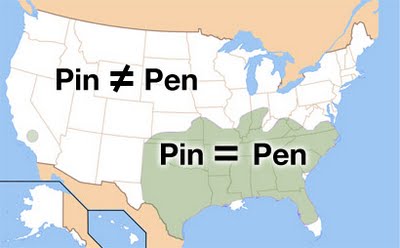 The first
basic task of language learning is learning to hear certain phones as phonemes and
learning not to hear others.
The first
basic task of language learning is learning to hear certain phones as phonemes and
learning not to hear others.